What’s “normal” infant sleep?
There isn’t one “normal” pattern - there’s a range that narrows with age. In the early months, healthy babies can look very different from one another. As the body clock matures, things gradually become more predictable. From 4–12 months, many babies do well with about 12–16 hours across 24 hours (including naps) over the course of a week, not every single day.
It’s also normal for babies to wake at night throughout the first year. A sizeable minority (~27%) of 12-month-olds still don’t sleep through most nights - that’s compatible with normal development. Treat “sleeping through” as a milestone, not a deadline.
Typical versus wider range
Use this as a guide, not a scorecard. Totals include naps and are best judged as a week-to-week average.
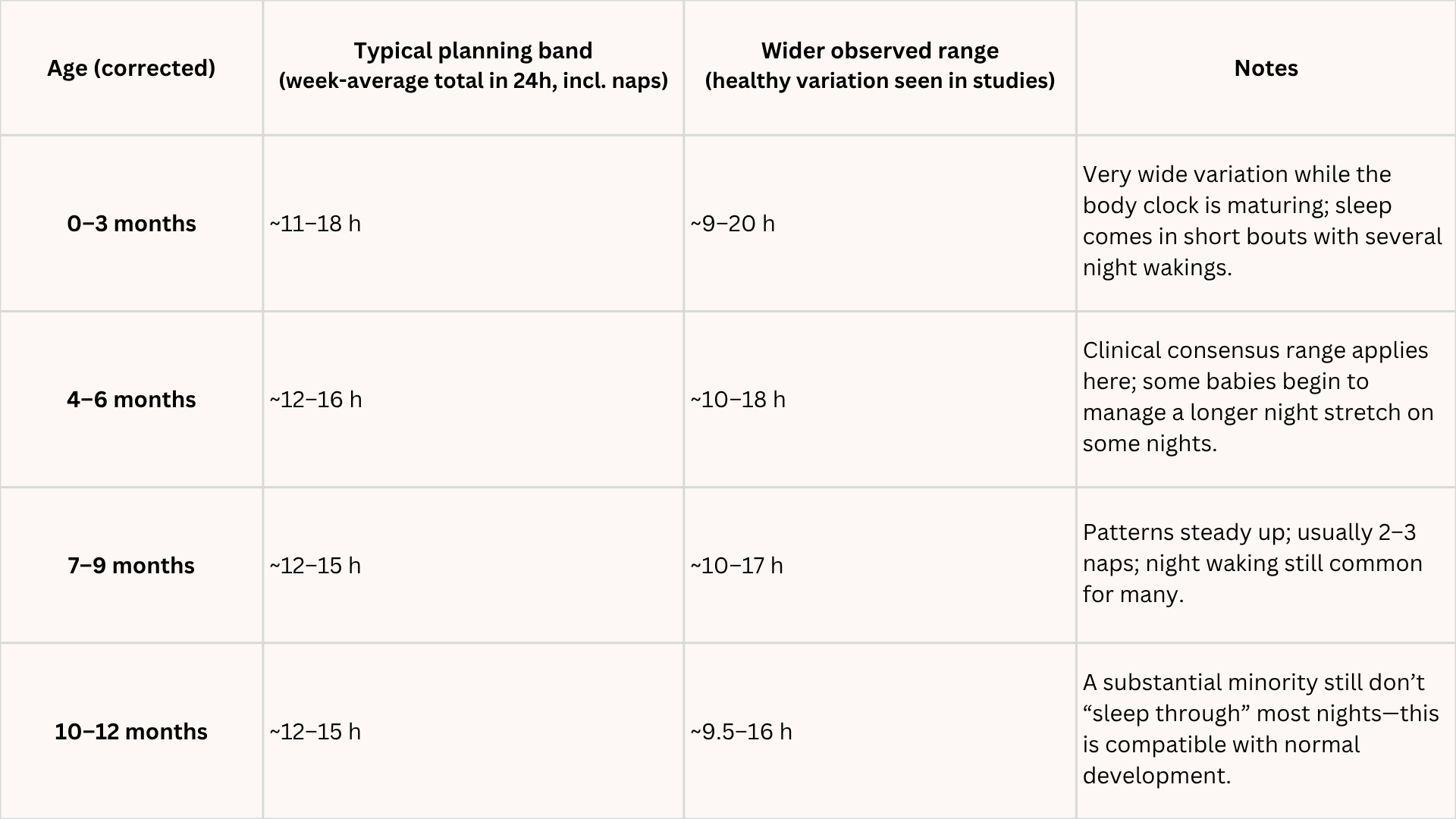
Typical and wider ranges of total sleep across 0–12 months (including naps). Plan within the inner band; the outer band shows healthy variation seen in studies. Judge totals over a week, not a night.
Where these figures come from
• The planning band for 4–12 months uses the widely adopted AASM consensus (12–16 h/24 h including naps). Under 4 months, there’s intentionally no fixed target because normal variation is very large.
• The wider ranges reflect UK BASIS summaries of research (for example, charts after Galland et al.), showing the spread seen in healthy babies at each age band.
Why babies vary (and why that’s okay)
Biology: Newborn sleep is driven by frequent feeding, small stomach capacity and a body clock that’s still switching on. Several night wakings are normal in early infancy. 2023-Basis-Normal-Infant-Sleep
Context: Home set-up (light/noise), family rhythms, caregiving patterns, living space and culture all nudge timing and totals—so your “normal” may not look like your friend’s, and that’s fine. 2023-Basis-Normal-Infant-Sleep
Temperament and development: Sensitivity, growth spurts, illness, jabs and new skills (roll/crawl/stand) create perfectly normal turbulence inside the range. 2023-Basis-Normal-Infant-Sleep
Feeding pattern: Breast/formula/combination can change stretch length (for example, formula may yield longer single bouts earlier), but 24-hour totals are often similar. Choose feeding for health and values; shape sleep gently and responsively. 2023-Basis-Normal-Infant-Sleep
Expectations matter (and the research backs that up)
Parents’ beliefs and expectations shape how we respond at bedtime and overnight - and those responses influence consolidation (how easily babies link sleep cycles). In a randomised clinical trial (9–18 months), families who started with higher tolerance for short, expected protests and lower distress-attribution (not reading every stir as distress) saw larger improvements. Those parent factors also improved over the month as sleep improved - confidence grows with consistency.
Why this helps: holding realistic ranges (rather than rigid targets) makes it easier to keep your response calm and predictable for a few nights—the lever that actually changes sleep. From 4–12 months, aim to sit within about 12–16 h/24 h most days across a week.
How to use ranges so they actually help
Band of normal, not a bullseye. The planning band shows where most babies sit; the wider range shows the outside edges you can still see in healthy infants - especially during growth spurts, illness or nap transitions. Compare to last week, not last night. Keep a light 7-day note of settle time, number of fully-awake periods, longest stretch and total day sleep. Look for gentle trend lines (quicker settles; less awake time).
Remember the 24-hour system. Days shape nights; nights reset days. Enough day sleep (not too little, not too late) supports easier evenings and steadier nights.
Match bedtime to your overnight plan. How your baby falls asleep sets the template for overnight. Align falling-asleep conditions with how you’ll help at 2 a.m. (same place, same kind of comfort).
Structure without rigidity. Predictable patterns beat strict clock-watching, especially under 6 months.
“Sleeping through”: clear up the definitions
Different people mean 5 hours, 8 hours, or 22:00–06:00. Different definitions create different expectations. Treat it as a milestone that arrives at different times; focus first on quicker resettles and shorter fully-awake periods.
When to pause and seek help
If you’re worried about growth/feeding, breathing looks effortful, snoring is persistent or loud, your baby seems in pain, or it’s hard to keep sleep safe (flat, firm, clear space; back to sleep), speak with your Health Visitor or GP. Otherwise, most ups and downs sit within normal development.
Reassurance to take with you
Your baby’s sleep sits within ranges that narrow with age.
From 4–12 months, about 12–16 hours per 24 h (including naps) is a helpful weekly guide.
Night waking can be normal and hard. You can make it easier with small, intentional tweaks and consistent, calm responses—confidence usually grows as sleep improves.